Creating your own silicone orthoses to help your patients relieve and protect their feet from friction or bone deformities is not always easy. How to choose the right hardness? Podialux, your store specialized in equipment for different techniques like orthoplasty in France, gives you some tips for succeeding as a pedicurist/podiatrist.
Some tips for a successful orthoplasty
What is an orthoplasty and how to succeed in it?
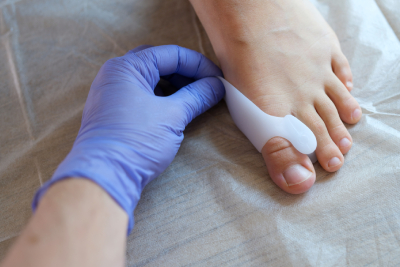 Orthoplasty, like orthonyxia, is a procedure conducted by a pedicurist/podiatrist that involves the creation of custom-made orthoses to isolate painful areas of the foot. For this, silicone is used, which is molded into different shapes also known as orthoses. These are then placed on the foot at the necessary location depending on the treatment. They can also be placed between the shoe and the foot to prevent the risk of friction and redness. All procedures are thus different as they are custom-made according to the patient's needs.
How to make a protective orthoplasty: choosing the right silicone
To successfully apply an orthoplasty, one of the main points of attention remains the choice of equipment and materials used. The silicone used by pedicurists varies according to its hardness, also known as shore. This is classified on a scale from 1 to 45, with 45 being the highest degree of hardness and 1 being the softest value.
The choice of shore is of course subject to change depending on the treatment and the patient's needs. It is important to know that a low shore resembles a protective prosthesis. The highest degrees correspond to a corrective prosthesis. The line is very fine, and it is crucial to pay particular attention to it. Choosing the right silicone is thus essential to best treat the patient and help them recover more easily.
Take a training course to successfully apply an orthoplasty
Before diving in, it is more than recommended for every pedicurist/podiatrist to train in orthoplasty. This allows for a better distinction between the different silicone hardnesses available and to more easily discern the line between protective and corrective orthoses.
Want to know more about applying toe orthoses in France?
Do you want to know more about orthoplasty and how to succeed in it? Would you like to ask us a question or two? Then you can contact us, either by phone or via our online form. Our teams will respond as soon as possible.